

Strega Nona in the Streets, Baba Yaga in the Sheets

Why authenticity lives in the space
between comfort and chaos

I feel like my blog is where my weird comes out.
Not the performative kind of weird. Not the “look how quirky I am” weird. My blog has become the place where I slow down and follow a thought all the way through. It’s where I let myself wander a little - to pull an idea apart, turn it over, and see what’s underneath. Tangents included.
I know this is a "business" and a "business blog" and some dusty old white dude would tell me it's "inappropriate," but I think todays blog has actually helped me understand why I feel such a conviction to allow all of me show up in my business. This is why, when you see my stories on Instagram, that you can't tell if you're looking at my personal page or my business page. It's intentional. Sorry not sorry.
I saw this sticker “Strega Nona in the streets, Baba Yaga in the sheets” a while ago. So I did what any meme-loving-millennial would do and I asked ChatGPT to analyze this for me. Here's a quick refresher on Italian and Slavic witch folklore:
Strega Nona
A character from Tomie dePaola’s children’s books, Strega Nona is a kind, grandmotherly Italian witch known for her magical pasta pot who accidentally buries an entire town in spaghetti. But only because she loves and cares for everyone. We all know how hard it is not to accidentally feed an entire village when measuring pasta.


Baba Yaga
A figure from Slavic folklore, Baba Yaga is an ancient and unpredictable witch who lives alone in the forest in a hut that stands on chicken legs. She moves from place to place when she is found, and it is the luck of the draw whether she will eat you or help you if you seek her out. She is know for her wisdom and ruthlessness. Very feral. Very unhinged.
So after I figured out what the meme meant, I chuckled to myself. And then I couldn't stop thinking about it. It literally rolled around in my brain for a week.
On the surface, it’s playful - a riff on a familiar format, a clever contrast. But the longer I sat with it, the more it felt like a surprisingly accurate shorthand for something I’ve been unraveling for years: the tension between how we show up in the world and who we really are when no one is watching.
Strega Nona is comfort. She is domestic magic. She feeds people. She keeps things running. She is trusted, kind, dependable. Baba Yaga, on the other hand, lives at the edge of the forest. She answers to no one. She is powerful, unpredictable, and eats people she doesn't like. She does not soften herself to be understood.
We tend to treat these as opposites. As if embodying one means excluding the other.
But what if they’re not opposites at all?
What if authenticity isn’t about choosing between them, but about allowing both to exist without apology?
I think many of us, especially women, are taught early on to edit ourselves into something legible and safe. We learn which parts of us are welcome and which parts are better kept quiet. We learn how to be capable, nurturing, agreeable. We learn how to be Strega Nona.
And for a long time, that feels like the whole story. Until it doesn’t.
Because there is usually another self living underneath - the one that wants more, questions more, refuses to be easily categorized. The one that feels deeply, changes her mind, burns things down when they no longer fit. The Baba Yaga self. The one we’re often told is “too much,” or “inconvenient,” or “hard to love.”

So we compartmentalize. We behave one way in public and another way in private. We perform balance. We try to smooth out the edges so no one feels uncomfortable, including ourselves. But something about that meme made me wonder if the problem isn’t that we’re divided, but that we’ve been taught to see division as a flaw.
I see them as order and chaos. One cannot exist without the other. I've spent my life pushing Strega Nona to the front and pretending like I have everything organized, tidy, and under control But my skin has become too tight trying to keep Baba Yaga tamped down so no one sees the wild, man-eating bog witch raging against the patriarchy and rebelling against societal norms.
Wholeness comes when we accept both. Neither one is wrong or right, but both must be given recognition. We accept the cycles of nature without question - decay feeds blooms, seasons cycle through life and death - but are unwilling to acknowledge our inner dichotomy. Why do we expect ourselves to be simpler than the world we live in?

I’ve started to believe that being authentic doesn’t mean being consistent all the time. It doesn’t mean choosing a single, coherent identity and sticking to it forever. It means being honest that we contain contradictions and freely letting those contradictions breathe.
You can be nurturing and fiercely protective. You can be soft-spoken and unyielding. Kind and assertive. None of that makes you fake. It makes you whole. In fact, I think we recognize and admire those qualities in others and applaud them, while seeing them as faults within ourselves.
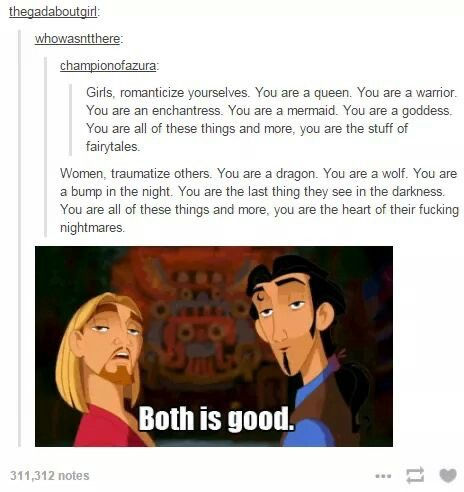
January feels like the right time to sit with this. The noise is lower. The pace is slower. It’s a month that invites reflection instead of performance. A month for noticing what parts of yourself you’ve been keeping on a short leash. And why.
Maybe authenticity isn’t about becoming someone new this year. Maybe it’s about reclaiming the parts of yourself you’ve learned to hide. Maybe it’s about letting Strega Nona tend the hearth and trusting Baba Yaga to guide you through the dark.
Both are wise. Both are necessary. Both are already yours. And maybe the truest kind of magic is letting them live in the same body, the same life, without asking either one to shrink.


Comments